
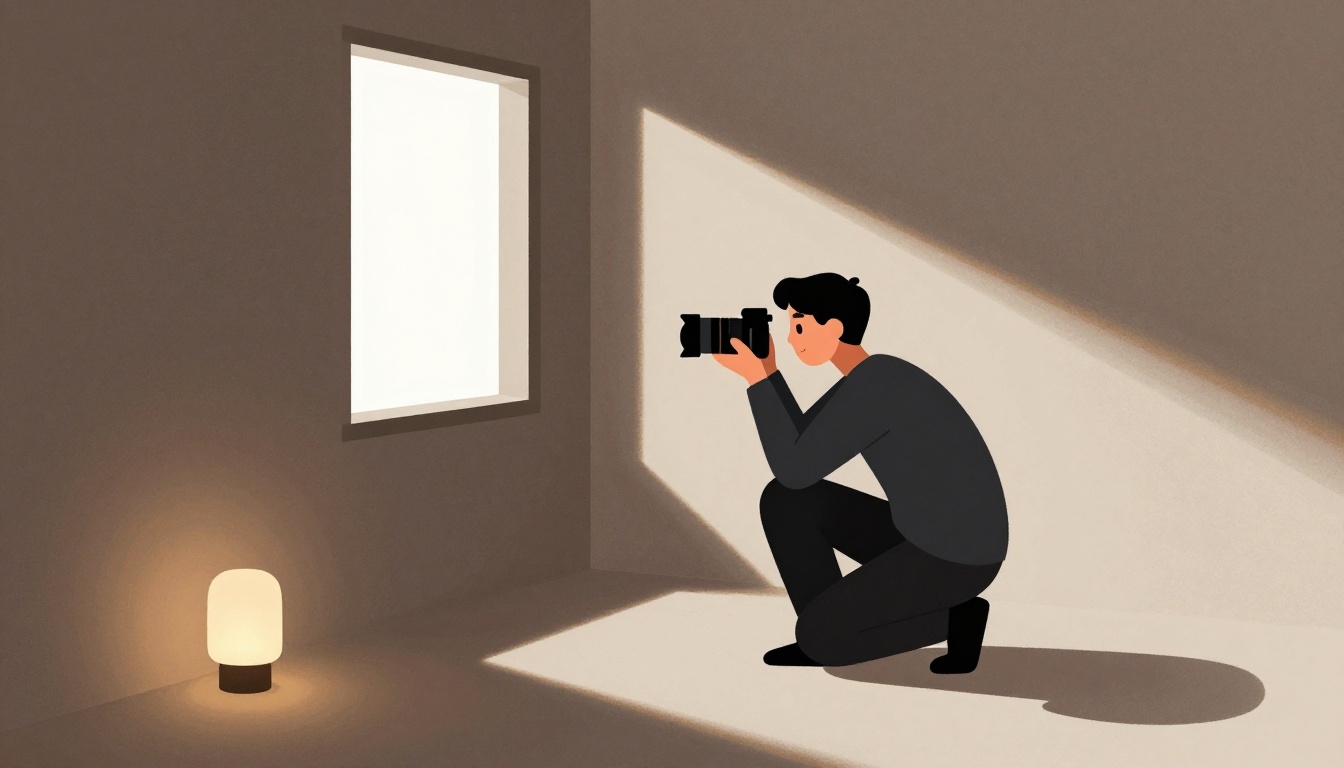
According to interior photography guidance, what is the main purpose of using a shallow depth of field like f/2.8 in a small space?
Select one answer.
Why small spaces feel impossible (and why they aren't)
Tight rooms fight back. You can't back up far enough, the light is uneven, and every wide shot risks distortion. But atmosphere doesn't require square footage. It requires control of light, depth, and restraint.
Interior and architectural photographers face the same constraints: physical space limits, mixed light temperatures, awkward angles, and the challenge of capturing a room from a single vantage point (ShupeStudios). The fix is a repeatable process, not better gear.
Start with the light, not the furniture
Lighting gives photos depth and life, and in small spaces it matters even more (Click Magazine). Before you move a single object, walk the room and find where the light actually falls.
- Identify the strongest natural source (usually one window) and shoot toward or across it, not away.
- Turn off overhead lights. Overhead-only lighting flattens a room and kills mood instantly.
- Add one or two low, warm lamps at different heights to layer the light.
- Watch color temperature. Warm light sits around 2700–3000K, cool white around 3000–5000K, and daylight around 5000–6500K. Mixing them without control creates muddy color (ShupeStudios).
Get back as far as you can
Every inch matters. Maximize the distance between camera and subject to reduce wide-angle distortion (Austin LaRue Photography).
- Step outside the door frame and zoom in until the frame edge just disappears.
- Lean the tripod into a corner to steal a few extra inches.
- Use a mini tripod on a table or shelf when floor space runs out.
- Tether or use a flip-out screen so you're not stuck behind the camera.
Choose the lens deliberately
Lens choice is critical: too narrow and you lose the room's personality, too wide and you get distortion. The goal is the widest lens that doesn't distort in that specific setting (ShupeStudios).
A longer lens also works. Cropping in with a telephoto isolates a key architectural detail and forces you to simplify, which is often exactly what a small space needs.
Let shadow and depth of field do the work
Atmosphere lives in what you don't show. A shallow depth of field, around f/2.8, blurs distracting foreground objects so attention stays on the design features that matter (Austin LaRue Photography).
Moody photography focuses on shadows and depth rather than overexposure, and it tends to evoke an emotional response instead of documenting technical light (IDCO Studio). That style suits spaces that are already a little moody or serious.
Mix your distances
A common mistake is shooting everything from the same distance. Photograph the space the way people experience it: from afar, in intimate detail, and everywhere in between (ShupeStudios).
For a small room, that means a tight detail of texture, a mid-range shot of a corner vignette, and one wider frame that establishes the whole space.
A practical checklist
- Scout the light before styling anything.
- Kill overheads; layer two or three low, warm sources.
- Back into the doorway or corner and zoom in.
- Pick the widest lens that doesn't distort.
- Open up to f/2.8 to soften foreground clutter.
- Shoot wide, mid, and detail frames of every scene.
- Balance window brightness with the room using multiple exposures if needed.
Quick quiz: test your understanding
Before you shoot your next tight interior, check one core principle.
Question: According to interior photography guidance, what is the main purpose of using a shallow depth of field like f/2.8 in a small space?
- A) To blur distracting foreground objects so focus stays on key design features
- B) To make the room appear physically larger in the frame
- C) To increase the overall brightness of the image
Correct answer: A. A shallow depth of field helps blur distracting foreground objects, allowing the focus to remain on the more important design features (Austin LaRue Photography).
How the Featured Expert Can Help
Adrienne Leigh Moore is a Bay Area photographer specializing in atmospheric, storytelling photography for brands, businesses, and individuals. She offers immersive collaborations and nature photography services, targeting luxury eco-retreats and design-forward spaces. Her work has been featured in Architectural Digest, 7x7, CB Magazine, Caribbean Living Magazine, and Voyage LA. You can explore her work at adrienneleighmoorephotography.com.